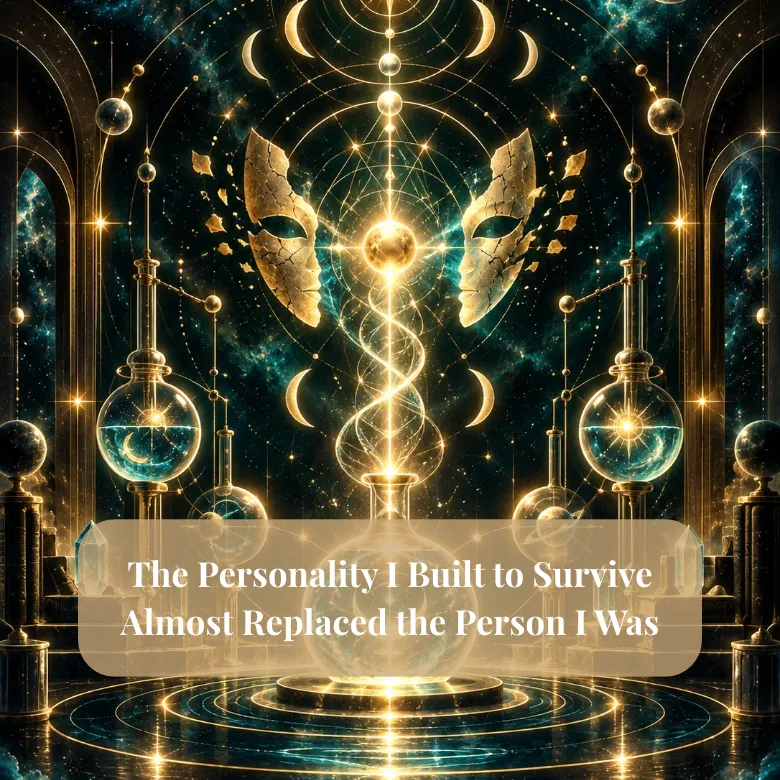
The Personality I Built to Survive Almost Replaced the Person I Was
"Being capable of becoming almost anyone doesn't mean you should have to become someone else to belong." The Wild Signal
Introduction:
What happens when you're so good at becoming what everyone needs that you forget you're allowed to be yourself?
I have a rather impressive superpower.
I can walk into almost any environment, read the room, figure out what makes people comfortable, and adapt accordingly.
Different personalities? No problem.
Unspoken expectations? I'll probably notice them before anyone says a word.
Someone uncomfortable, overwhelmed, angry, or disappointed?
My brain is already calculating seventeen ways to make the situation better.
For a long time, I thought this was simply my personality. And in some ways, it is.
I'm naturally curious. Observant. Adaptable. Interested in people and how they work.
But somewhere along the way, an ability became an obligation.
And the person I was underneath all that adaptation started disappearing.
When adaptation becomes automatic
There's a difference between adapting because you want to and adapting because your nervous system has learned that belonging, safety, or peace depends on it.
One is flexibility. The other can become survival.
When you spend enough time monitoring the emotional temperature of a room, you begin making adjustments before you're even consciously aware of them.
You soften an opinion. You change your tone. You hide your excitement.
You become less intense, less emotional, less curious, less much.
Not because someone explicitly told you to disappear.
Sometimes nobody has to.
You learn which parts of yourself create friction, and you quietly put those parts away.
Eventually, the process becomes so seamless that other people may never notice.
They think they're meeting the real you.
And you may not realize how much you're editing yourself either.
The hidden cost of being easy to love
For years, I could fit into environments that didn't truly fit me.
I could make friends, maintain conversations, understand perspectives, and contribute meaningfully.
People could genuinely like me. But I could leave those interactions feeling strangely empty.
I was included. I was appreciated. Sometimes I was even needed.
Yet I didn't feel fully known.
Because belonging to a group and belonging as yourself are not necessarily the same thing.
I began realizing that much of my loneliness wasn't caused by a lack of people.
It came from the distance between the person people were interacting with and the person I felt myself to be.
I was being accepted for how successfully I adapted, not necessarily for everything I actually was.
That realization changed how I understood decades of my life.
The difference between masking and authenticity
Masking is often discussed in connection with neurodivergence, but self-presentation and social adaptation exist across many human experiences.
We all adjust ourselves to some extent.
The question isn't whether we adapt. It's whether we still have a choice.
Can I disagree without feeling responsible for someone else's reaction?
Can I be enthusiastic without immediately making myself smaller?
Can I say no without producing a fifteen-page defense of my decision?
Can I be quiet because I want quiet, rather than because I've decided my thoughts are inconvenient?
Can I let someone misunderstand me without urgently trying to manage their perception?
Those questions became more useful than asking whether I was being perfectly authentic every second.
Because authenticity isn't refusing to adapt.
It's being able to adapt without abandoning yourself.
Rediscovering the wonderfully ridiculous parts
One of the most surprising parts of reclaiming myself has been discovering that my natural personality never actually disappeared.
It was still there.
The curiosity.
The absurd humor.
The tendency to connect ideas that appear completely unrelated.
The intense fascination with ordinary things.
The desire to experience weather rather than merely observe it through a window.
The ability to become deeply invested in a question nobody else thought to ask.
The chaotic creative energy that can turn one small idea into an entire universe before lunch.
None of it needed to be invented.
It needed permission.
And perhaps that's why this stage of life feels less like becoming someone new and more like returning home.
You don't have to become a better version of yourself
I have a complicated relationship with the phrase become your best self.
It sounds empowering.
But for someone who has spent years trying to become whatever version of themselves would finally be acceptable, it can feel like another assignment.
Another improvement project. Another personality to construct.
What if the goal isn't to become more impressive? What if it's to become less distorted?
To understand which behaviors genuinely reflect our values and which were developed to avoid conflict, rejection, or abandonment?
To retain the skills we gained through difficult experiences without continuing to live as though those experiences are still happening?
I don't want to throw away my adaptability.
It's useful. It's creative. It's part of how I understand the world.
I simply don't want it driving my entire identity anymore.
I want to choose when to use it.
And I want the freedom to be my strange, curious, enthusiastic, occasionally ridiculous self without checking whether everyone in the room has approved the performance.
Because here's what I've finally learned:
Being capable of becoming almost anyone doesn't mean you should have to become someone else to belong.
Decode your own signal
Ask yourself:
Which parts of my personality appear only when I feel completely safe?
What do I routinely minimize to keep other people comfortable?
Which adaptations are useful choices, and which feel automatic?
Who am I when nobody needs anything from me?
You may discover that the person you've been trying to become has been waiting underneath the adaptations all along.
The Wild Signal
Not a brand. A broadcast.